
TRADING BREAKTHROUGHS WITH AI"Give me a lever long enough and a fulcrum on which to place it, and I shall move the world." — Archimedes
"Give me a lever long enough and a fulcrum on which to place it, and I shall move the world." — Archimedes
Every trader now has access to the lever. Almost nobody has the fulcrum.


With the right setup, skills & tech stack, everyone now has a quant PhD on staff.
This isn't an 'AI Course', it's a whole new way to fast track quant trading research.
*It's free for Alpha (annual) Algo Collective members (that's the only way to get it)
Put your quant intern to work!
An AI that reads and writes files, runs your backtesting platform from the command line, analyses the output, and drafts the research report is functionally a research assistant — one that works at 2am, never tires of your questions, and costs less per month than a single data subscription.
The question is no longer whether you have access to that capability. It’s whether you can direct it.
Direct it badly and you get the most expensive way ever invented to lie to yourself: an AI asked to “build a profitable strategy” will hand you exactly that — something that *looks* profitable. The code runs. The equity curve climbs. None of it means anything.
This course teaches you the “direct it well” part. And it hands you the fulcrum I use every day.

The core promise:
By the end of this course you will be fully set up and orientated with Claude Code, RealTest and Norgate data (a free data source will suffice), running a genuine research pipeline of your own.
The transformation is specific: from “I get the basics of systematic trading” to “I run an ongoing pipeline for researching and developing meaningful systematic models.”
Concretely, you’ll be able to:
- Take a simple idea into deep, statistically honest research, learning about your models as you build them
- Safely let Claude work unsupervised for hours, delivering meaningful research while you do other things entirely
- Minimise overfitting because the process itself is anti-overfitting by design, not bolted on afterwards
- Produce markdown research briefs you can browse in Obsidian (or Notion), turning every project into a permanent, compounding research asset
- Combine strategies intelligently into a portfolio, and judge each one by the right scorecard
- Never ask a “silly question” in a forum again. Your AI is a private RealTest coach, on call at any hour, with infinite patience.
That last one is the secret bonus, and it’s bigger than it sounds. More on that below.
The Idea That Holds It All Together
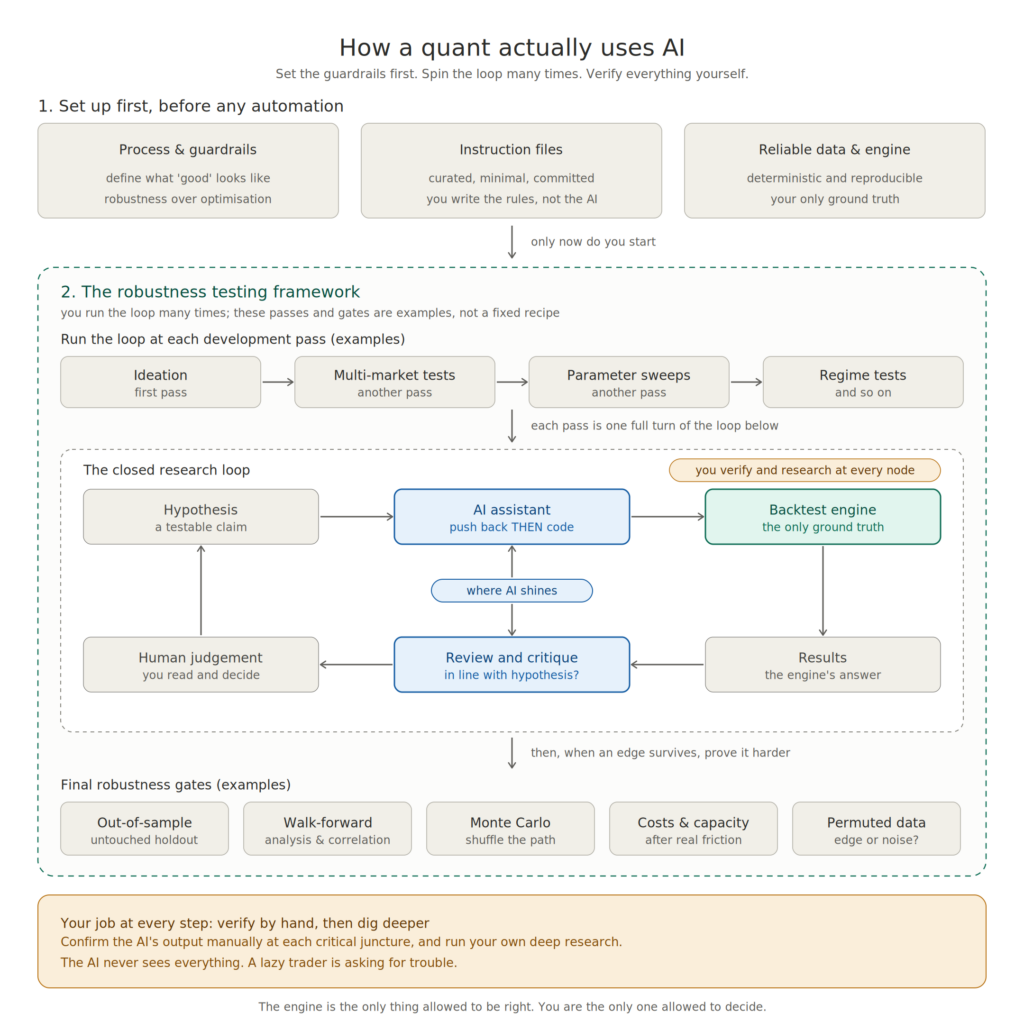
The model that actually works is a closed loop, and it's the premise of the entire course:
- You form the hypothesis and orchestrate. You decide what to test, in what order, and why.
- The AI intern sharpens the spec, writes the code, iterates tirelessly, analyses output and drafts the reports.
- RealTest on Norgate data delivers the verdict. Same script, same data, same answer, every time. It has no interest in your feelings. The referee.
The boundary is the key: the AI touches everything in the loop except the verdict. Author and judge must never be the same entity.
This matters because AI has driven the cost of plausible-looking strategies to nearly zero, which makes overfitting *more* dangerous, not less. Your entire edge has migrated to validation. The course is built around protecting exactly that.
Get a live preview of the first module from within the Collective even on a Core (monthly) subscription. (you even get 3 days free to check it out)
Learn about Algo CollectiveThe Payload
You Get My Actual Instructional Files / Skills

Trained AI with Persistent Memory
- Here's what most people miss. The third component of the loop, alongside the engine and the orchestrator, is a folder of instruction files: the place where an expert tells the AI how their domain *actually* works. Procedures, conventions, decision rules, known errors, edge cases, the specific corrections that turn confident output into correct output.
- Think of it as accumulated scar tissue. The agent supplies the muscle; the expert supplies the scars. Anyone can be handed an agent. Nobody can be handed scars — until now.
- Externalising your expertise this way makes you dramatically more productive, and simultaneously makes your edge copyable. That's precisely why you'll find plenty of excellent essays online about writing AI skills, and precisely zero systematic traders walking you through their folders.
I Really Trade. I Use This Research Stack
- This is the offer: I'm providing my skills. Every file, every guard-rail, every hard-won gotcha, working from day one.
- Provenance matters here, so let me be blunt about it. These files weren't assembled by a content marketer who once interviewed a trader. They were built, corrected and hardened across years of daily research on my own systems and my own capital, and they're the same files running in my Research Lab right now.
- Every rule in them exists because at some point its absence cost me something: a phantom trade that quietly corrupted a week of results, a survivorship-biased universe that flattered a dead strategy, an optimisation that produced a beautiful lie. The AI is the easy part; anyone can rent that. Judgement earned at the screen is what you can't download.

You’re not buying a template. You’re inheriting a working practice.
A Complete RealTest Education, Hidden Inside
Here's a claim I'll stand behind: once this framework is in place, you may never need another RealTest course.
The setup wires the complete RealTest language reference and the full user guide into the AI’s reference layer, governed by strict rules: consult the documentation, cite what it says, never guess; if the docs are silent, verify with a small empirical test. Ask a bare chatbot an obscure RealTest question and you get confident hand-waving. Ask your configured Claude the same thing and you get a cited answer you can check.
Then use it like a private tutor. “Explain this script line by line.” “Give me an exercise on exits.” “Show me where the guide says that.” Every level, any hour, infinite patience, and never a silly question asked in public.
The hidden learning loop is the part nobody expects: you get better at RealTest as a side effect of doing research. Every session walks you through working scripts, real settings and cited documentation, and each “why did that happen?” answered properly becomes durable platform knowledge. My own RealTest fluency grew exactly this way.
An uncomfortable truth for other course sellers: with this framework in place, every other RealTest course is effectively contained within Claude — if it’s used correctly. This course teaches the “used correctly” part.
Here's What We Cover
19 Modules Across Three Parts
MODULE 01: Stack Setup

Overview
Introduction — Your Quant PhD On Staff. The trap, the closed loop, the skills folder as the real asset.
Part I — Setup (Modules 1–5).
The plumbing, done properly. Install Claude Code, RealTest and Norgate, build the Research Lab folder, and verify the whole loop end to end with one prompt. Add the Python analysis layer. Learn to personalise the files safely, stay current as RealTest updates without ever clobbering your customisations, and master the operator's manual for working with Claude itself: auto mode, memory, what it can and cannot be trusted with.
Part I — Setup (Modules 1–5).
The plumbing, done properly. Install Claude Code, RealTest and Norgate, build the Research Lab folder, and verify the whole loop end to end with one prompt. Add the Python analysis layer. Learn to personalise the files safely, stay current as RealTest updates without ever clobbering your customisations, and master the operator's manual for working with Claude itself: auto mode, memory, what it can and cannot be trusted with.
Modules
1.01 - Setup the Environment
1.04 - Staying up to Date
1.02 - Add Python
1.05 - Working with Claude
1.03 - Personalising & Tweaking
MODULE 02: The Instruction Files
Overview
Part II — The Instruction Files (Modules 6–15).
The heart of the course: one module per file in the folder. The design philosophy of the whole system. `CLAUDE.md`, the master file every session reads. The strategy-builder that forces spec-before-code. The research briefs that serve as human record and AI memory at once. The reference layer that makes Claude a citing, non-guessing RealTest tutor. The self-updating error log, so no problem is ever solved twice. The optimising rules: plateaus not peaks, walk-forward validation, the guard-rail on AI's most dangerous capability. The portfolio builder, which makes "should I combine these?" a properly hard question. The behavioural gotchas file, for results that run perfectly and mean the wrong thing. And the data-coverage file that keeps every backtest survivorship-free and honest about how far back it can go.
The heart of the course: one module per file in the folder. The design philosophy of the whole system. `CLAUDE.md`, the master file every session reads. The strategy-builder that forces spec-before-code. The research briefs that serve as human record and AI memory at once. The reference layer that makes Claude a citing, non-guessing RealTest tutor. The self-updating error log, so no problem is ever solved twice. The optimising rules: plateaus not peaks, walk-forward validation, the guard-rail on AI's most dangerous capability. The portfolio builder, which makes "should I combine these?" a properly hard question. The behavioural gotchas file, for results that run perfectly and mean the wrong thing. And the data-coverage file that keeps every backtest survivorship-free and honest about how far back it can go.
Modules
2.01 - The Process, Embedded in Files
2.06 - Known Errors
2.02 - Claude.md - The Master File
2.07 - Optimizing Rules
2.03 - Strategy Builder
2.08 - Portfolio Builder
2.04 - The Research Briefs
2.09 - RealTest Script Notes
2.05 - The Reference Layer
2.10 - Norgate Index Coverage
MODULE 03: Doing the Work
Overview
Part III — Doing the Work (Modules 16–18).
The craft. Reading the three output CSVs and every metric in them, with TYPE × GOAL scorecards so you stop judging trend models on Sharpe. Research-first prompting: causal mechanisms, significance floors, portfolio-first thinking, and how to design the test that would kill your own idea. Then the full nine-step loop you'll run for years, including the step nobody else will tell you about: verifying the intern's work yourself.
The craft. Reading the three output CSVs and every metric in them, with TYPE × GOAL scorecards so you stop judging trend models on Sharpe. Research-first prompting: causal mechanisms, significance floors, portfolio-first thinking, and how to design the test that would kill your own idea. Then the full nine-step loop you'll run for years, including the step nobody else will tell you about: verifying the intern's work yourself.
Modules
3.01 - Analysing Results
3.03 - Where To From Here?
3.02 - It's All About the Prompts
What You'd Miss Without This
Try doing serious quant research without Claude Code and this setup, and here’s what you’re giving up.
- Throughput. One properly-specified overnight session now does what used to take me a week. Breadth of testing compounds: more universes, more variations, more robustness checks per idea, because the marginal cost of the next test has collapsed.
- The referee’s discipline. Without the closed loop, you become both author and judge of your own backtests. That’s not a workflow, it’s a conflict of interest.
- Compounding memory. Without the error log and the notes file, every session starts amnesiac. You re-solve the same import failure annually for a decade. Here, every error is solved exactly once, forever.
- The guard-rails. Unconstrained AI is a very fast overfitting engine. The optimising rules, the significance floors, the survivorship-free universe conventions: these are the difference between research and expensive fiction.
- The coach. Every syntax question, every “why did it do that”, every “explain this script line by line” — answered instantly, with citations from the actual documentation, instead of a forum thread three days later.
- The archive. Every study, pass or fail, files a brief. Your market understanding compounds either way. Without it, failed research evaporates and you learn nothing twice.
The honest framing: this isn’t AI replacing your judgement. It’s AI doing more than you ever could alone, inside a structure that stops it from thinking for you.

Who It's For, and What You Need
Built for basic-to-advanced systematic traders, rule-based investors going systematic, and quant-curious traders who want a fast track — with a private coach answering every question along the way.
You’ll need a Windows PC, RealTest with Norgate Data, and a Claude subscription (Pro minimum; higher plans buy longer unsupervised sessions). The principles transfer to any AI, any platform, any OS. The files are ready-made for this stack.
The Bottom Line
A practical, research-first toolkit that helps you move from “gut feel” to statistically defensible decisions.

The tools are available to everyone. The instruction files, the methodology, the scar tissue — those are not. This course hands you all three, then teaches you to run the loop: hypothesis, test, verdict, brief, next question.
The intern is ready. The referee is waiting. The folder does the heavy lifting.
Your only job is to ask better questions — and we teach that too.
In summary: nineteen modules take you from a bare Windows PC to a running research pipeline: the setup, verified end to end; every instruction file explained — what it does, when it fires, why it exists; then the craft of reading results honestly and asking research questions that actually deserve an answer.
And there’s that bonus hiding inside that might be worth the price alone: with the complete RealTest documentation wired into the AI as a citing, non-guessing private tutor, you may never need another RealTest course. Ask it anything, at any hour. “Explain this script line by line.” You’ll learn the platform as a side effect of doing real research on it.
The transformation is specific: from “I get the basics of systematic trading” to “I run an ongoing research pipeline.”
The intern is ready. The referee is waiting. The scar tissue is included.
The only question left is what you’ll test first.

Simple Access - Just Become an Alpha Member of the Collective
You can try to piece this together yourself — Marsten ships RealTest with the working foundation for Claude integration — but here you get acccess to my thought process and pipeline for research, which shapes everything.
You’ll get a guided, research-first framework, a library of Claude skills, and the know-how to test, refine, and make it your own over time — with community and mentor support to keep you calibrated and accountable.
This isn’t about hype. It’s about outcomes:
- Build real quant skills (confident process, not guesswork)
- Proceed step by step so there’s no guessing
- Get a detailed understanding of ‘why I work like this’
The earlier you build competence, the less tuition you pay to the market. Start now — before you spend another year “almost” getting it right.
Offering the course INSIDE the community is THE way to make sure you get all the guidance and follow-up that you need.
Yes, for the price of an introductory course, you get this, plus EVERYTHING ELSE INSIDE THE COLLECTIVE.
Frequently Asked Questions
Have more questions? Contact us
Do I need to be able to code?
No. You don’t need to start as a programmer — you need to start as a rule-builder. The course gives you working files and very detailed instructions on how to use them all with plain English prompting.
What software do I need?
RealTest and ideally Norgate data. You’ll also need a Claude subscription. The principles are universal, for sure, but there’s a great deal of focus on how to make Claude work with RealTest and Norgate Data.
What support do I get if I’m stuck?
You’ll have access to the community plus mentor support to help with questions, troubleshooting, and clarifying the research and testing concepts. As questions cluster, we’ll also run live deep-dives/webinars and add them into the course so it improves over time.
Is there a community, and what’s it for?
Yes. It’s there for accountability, idea cross-checking, troubleshooting, and staying sane in a market designed to hijack your emotions. Most traders fail in isolation; community compresses the learning curve and reduces unforced errors.
Do I already need substantial quant experience?
No. Experience helps, but the course introduces core testing concepts, definitions of key quantitative metrics, and foundational material so students new to quant analysis can fully benefit. Advanced users can ‘grab the files and start moving’.
I’m not technical.
You don’t need to start technical; you need to start defining rules. The core shift is moving from “feel” to “define,” and the course is built around that transition. Still, you have to have an interest in doing analysis with coding tools to become a proficient quant trader.